iqz: Lossless I/Q Radar Compression




iqz is a simple, fast, lossless compression codec for raw (I/Q) mmWave radar data which achieves modest compression ratios at fast speeds suitable for on-device encoding and in-dataloader decoding.
| Tartan* | I/Q-1M | |
|---|---|---|
| zstd-3 on raw bytes | 1.62x | 1.43x |
| iqz | 2.31x | 1.84x |
| Decode, 1 core (native) | ~3.4 GB/s | ~2.9 GB/s |
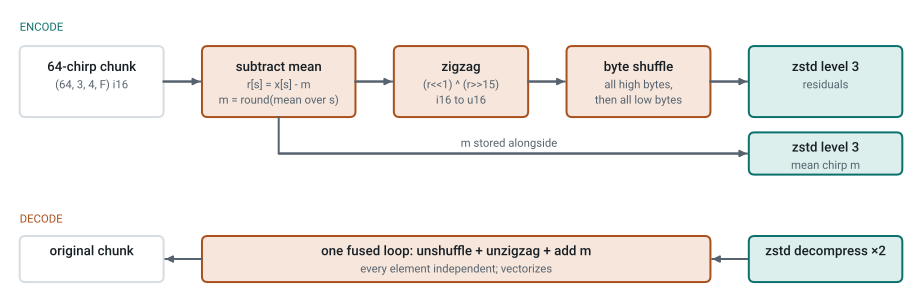
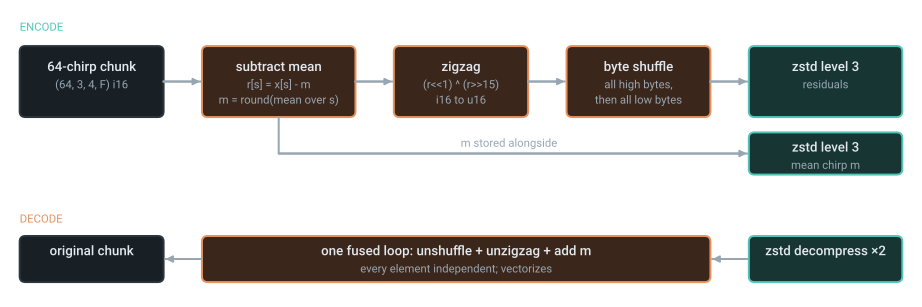
Each chunk of chirps (typically 64) is encoded by subtracting the chunk's rounded mean chirp, which removes static clutter and TX-RX leakage; zigzag-encoding and byte-shuffling the residuals; and compressing with zstd.
Usage
Install
Info
Prebuilt wheels with the native (Rust) backend are available for Linux (x86_64 and aarch64, e.g. Jetson and Raspberry Pi 4/5 with a 64-bit OS), macOS, and Windows, for Python 3.10 and later. On other platforms, pip builds from source, which requires a Rust toolchain. A pure numpy backend (using zstandard) is also included as a reference implementation.
Basic Usage
Performance Tuning
decode and Decoder.read return a new array on every call. Freshly allocated memory may have to be page-faulted in on first write, which can cost up to 40% of the decode throughput on chunks of a few MB, depending on the state of the memory allocator. For the full speed, decode into buffers which you allocate once and reuse:
iqz.decode_intodecodes one chunk into an existing array, e.g. a slice of a preallocated batch:Decoder.read_intoreads the next chirps of a stream into an existing array; chunks which fit entirely in the read are decoded directly into it.
The native backend releases the GIL while encoding and decoding, so multiple threads (e.g. dataloader workers) can decode in parallel.
Format
An iqz blob encodes one chunk of n consecutive chirps, where each chirp is a vector of M int16 samples, flattened in their on-disk order. No reordering is applied; in particular, the TI IIQQ interleave is left as is. All arithmetic is wrapping 16-bit integer arithmetic.
Encoding
Let x[s, k] be sample k of chirp s, for 0 <= s < n and 0 <= k < M.
- Mean chirp:
m[k] = round(mean_s x[s, k]), stored as int16. The reference implementations round half to even (np.round). - Residual:
r[s, k] = int16(x[s, k] - m[k]), wrapping on overflow. - Zigzag:
u = uint16((r << 1) ^ (r >> 15)), with an arithmetic right shift. This maps0, -1, 1, -2, 2, ...to0, 1, 2, 3, 4, .... - Byte shuffle:
residuals = [hi(u[0]), ..., hi(u[N-1]), lo(u[0]), ..., lo(u[N-1])], whereN = n * Manduis flattened in C order (chirp-major). - Blob:
u32le len(A) | A | B, whereA = zstd(m as int16 LE bytes)andB = zstd(residuals). Both are standard zstd frames (level 3 by default), which must record their content size in the frame header.
Info
The decoder does not depend on how m is chosen: any int16 vector gives an exact round trip, and the rounding mode only affects the compressed size (negligibly).
Decoding
Decompress A and B; then, for each element,
Each element is independent, so this loop vectorizes.
Shape
M and n are recovered from the content sizes of the two frames, which are 2M and 2nM bytes; see iqz.info. Only the per-chirp sample shape (e.g. (3, 4, 1024) for 3 TX, 4 RX, and 1024 fast-time samples) needs to be stored elsewhere.
The blob has no magic number, version, or checksum; integrity checks are left to the container (e.g. per-file checksums).